Houseplant Care for Beginners: 8 Low-Maintenance Plants for Apartment Living

Easy-care houseplants for apartments — eight forgiving species, how to read your unit’s light, and the watering habit that keeps any plant alive.
Why most plant deaths are about light, not skill
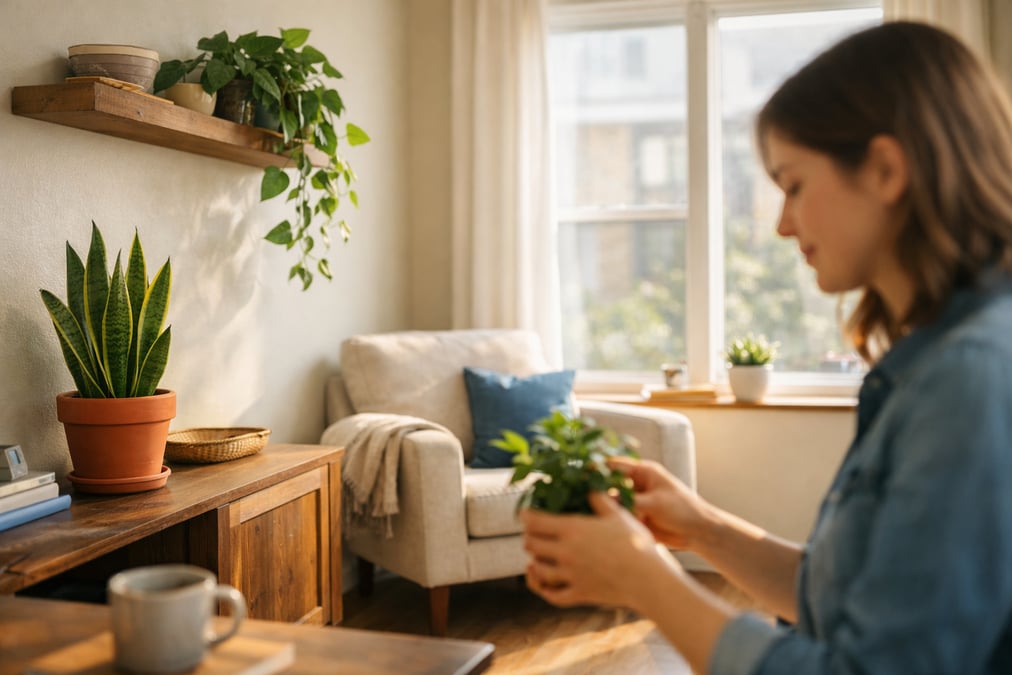
You are not a plant killer. You have probably just been buying plants for rooms they were never going to survive in.
Almost every “I have a black thumb” story is really a light-mismatch story. The plant came home from the store happy. It went on a shelf five feet from the nearest window, in a north-facing apartment, and slowly declined for two months. Then it died. The plant was fine. The shelf was the problem.
This guide does two things. First, it shows you how to read the light in your actual apartment — the single most important skill for keeping plants alive. Second, it gives you eight species that are genuinely forgiving, with the right pick for each kind of light.
TIP
If you only do one thing from this article, do the light test in the next section. It takes one day and saves you from buying the wrong plant for the wrong spot.
The one-day light test
You do not need a light meter. You need to spend one weekend day at home and observe.
At 10am, 1pm and 4pm, walk through your apartment and note:
- Which rooms have direct sunlight falling on the floor or wall? That is “bright direct” light.
- Which rooms are very bright but no sun is hitting any surface? That is “bright indirect” light. Usually 1-3 feet from a sunny window, or a few feet inside a north-facing window.
- Which rooms are clearly lit but you would not read a book in them without a lamp? That is “medium” light.
- Which rooms are dim enough that you turn on lights even during the day? That is “low” light. (Most interior hallways. Most bathrooms.)
That is it. You now know more about the light in your apartment than 80% of people who buy houseplants. Pair each plant on this list with the right zone.
A note on direction: if you live in the Northern Hemisphere (most of the U.S.), south-facing windows get the most direct sun, north-facing windows the least. East-facing windows get gentle morning light. West-facing windows get strong afternoon light, which can scorch plants pressed against the glass.
The eight plants
1. Snake plant (Dracaena trifasciata, formerly Sansevieria)
The most forgiving plant on this list. If you have killed three plants and you are about to give up, start here. Snake plants tolerate low light, bright light, infrequent watering and dry indoor air.
- Light: Anywhere from low to bright. Direct sun is fine for a few hours; avoid all-day baking against south-facing glass.
- Water: Once every 2-3 weeks in spring/summer, once a month in winter. Let the soil dry completely between waterings.
- The one mistake to avoid: Overwatering. If the leaves get soft, yellow at the base, you are watering too often.
2. Pothos (Epipremnum aureum)
The vining plant you have seen on every Pinterest board. Pothos grows long trailing vines and looks great cascading off a bookshelf, a kitchen cabinet or a hanging planter.
- Light: Medium to bright indirect. Survives in lower light but grows slowly and loses variegation.
- Water: Once a week. The leaves droop slightly when thirsty — a useful “tell”.
- The one mistake to avoid: Brown crispy leaf tips usually mean dry air. Group plants together to share humidity, or move it away from a heater vent.
3. ZZ plant (Zamioculcas zamiifolia)
The plant for travelers. ZZ plants store water in fat underground rhizomes, so they can go three weeks without you and look unbothered.
- Light: Low to medium indirect. One of the very few plants that genuinely thrives in a dim hallway or a bathroom with a small window.
- Water: Every 2-3 weeks. Less in winter.
- The one mistake to avoid: Overwatering will rot the rhizomes. When in doubt, do not water.
4. Spider plant (Chlorophytum comosum)
A classic. Spider plants grow long arching leaves and send out baby plants on stems, which you can snip and pot to share with friends or expand your own collection for free.
- Light: Bright indirect. They tolerate a wide range.
- Water: Once a week. They like consistent moisture but not soggy soil.
- The one mistake to avoid: Brown tips usually mean a sensitivity to fluoride or chlorine in tap water. Leave a pitcher of tap water out overnight before watering, or use filtered water.
5. Peace lily (Spathiphyllum)
The most communicative plant on this list. Peace lilies droop dramatically when they need water, you water them, and within a few hours the leaves perk up like nothing happened. Theatrical, useful, and they bloom indoors with white flowers a few times a year.
- Light: Medium indirect. They tolerate lower light than most flowering plants. Avoid direct sun.
- Water: Wait for the slight droop, then water deeply. Usually once a week, less in winter.
- The one mistake to avoid: Brown leaf edges mean mineral buildup. Flush the soil with plenty of water every couple of months to clear out salts.
6. Rubber tree (Ficus elastica)
If you want one statement plant, a rubber tree is hard to beat. Glossy dark-green (or burgundy, depending on the variety) leaves on a single upright stem. Grows tall over a few years.
- Light: Bright indirect. An east-facing window is ideal. They tolerate brighter light but the leaves can sunburn in direct south-facing sun.
- Water: Every 7-10 days in summer, every 2 weeks in winter. The top inch of soil should dry out between waterings.
- The one mistake to avoid: Sudden moves. Rubber trees drop leaves when they move to a new light environment. Find a spot you are happy with and leave it there.
7. Cast iron plant (Aspidistra elatior)
Named for surviving Victorian London townhomes where coal smoke and almost no light killed every other plant. The cast iron plant grows slowly but is essentially unkillable for an absent-minded owner.
- Light: Low to medium indirect. Great for the dim corner of a living room or a north-facing apartment.
- Water: Every 10-14 days. Tolerates being forgotten for an extra week.
- The one mistake to avoid: Expecting fast growth. This plant takes years to fill out a pot. If you want a fast plant, look at pothos.
8. Succulent grouping (echeveria, haworthia, jade)
For a sunny windowsill. A grouping of three or four small succulents in a shallow dish is one of the easiest displays you can build, and it looks deliberate.
- Light: Bright direct. South or west-facing windowsill is ideal.
- Water: Once every 2-3 weeks in summer, monthly in winter. Water the soil only, not the leaves.
- The one mistake to avoid: Stretching. If your succulent looks pale and is reaching toward the window with a long thin stem, it needs more light. Move it closer to the glass.
The one watering habit that keeps almost any plant alive
Most plant deaths happen because of overwatering, not underwatering. The mental model that helps:
- Most houseplants want the top inch of soil to dry out before the next watering.
- “Once a week” is a guideline, not a rule.
- Stick your finger 2 inches into the soil. If it comes out dry, water. If it comes out cool and damp, wait.
- When you do water, water deeply — until water runs out the bottom of the pot. Then let the pot drain. Do not let the pot sit in a saucer of water.
- In winter, most plants drink less. Halve your summer watering frequency.
If you do nothing else from this article, learn the finger test. It saves more plants than any moisture meter, app or schedule.
A note on pots and drainage
The cute ceramic pot you bought at the home store probably has no drainage hole. That is a problem. Roots that sit in water rot. Rotting roots kill plants.
You have two options:
Option A: Plastic nursery pot inside the cute ceramic pot. Keep the plant in the plastic nursery pot it came in (which has drainage holes), and just slide that into the ceramic pot. Take it out to water in the sink, let it drain, then put it back. This is what most plant people do, and it is the easiest approach.
Option B: Drill a drainage hole. Doable with the right ceramic drill bit. Mostly worth it for larger pots you really like.
What you should not do is put the plant directly into a pot with no drainage and just water it “less”. It is much harder than it sounds, and a single overzealous watering can finish the plant.
What about pets and toddlers?
Some of these plants are not pet-safe or toddler-safe if chewed. Specifically:
- Pothos, peace lily, ZZ plant, spider plant can cause mouth irritation and stomach upset if chewed.
- Rubber tree has a sap that irritates skin and is mildly toxic if eaten.
- Snake plant can cause stomach upset if eaten in quantity.
- Cast iron plant and most haworthias are generally considered pet-safer.
If you have a cat who chews everything, put the toxic-when-chewed plants on shelves or in rooms the cat does not access. Hanging plants are an option. For toddlers, the same idea: anything chewable goes above waist height.
For specific concerns about a plant your pet ate, the ASPCA Animal Poison Control Center has a hotline and a searchable database of plant toxicity at aspca.org/pet-care/animal-poison-control.
Start small
You do not need eight plants on day one. Start with two:
- One easy-care plant for a low-light spot (snake plant, ZZ, or cast iron).
- One easy-care plant for a bright spot (pothos, spider plant, or aloe).
Keep them alive for a month. Notice how they look the day before they need water. Notice how the new leaves start. Then add a third.
Within three months you will have a small collection that works for your apartment, and you will know exactly what kind of plant person you are. Some people stop at four plants and feel done. Some people end up with a small jungle. Both are correct answers.
The point is not the plants. The point is having a few living things in the apartment that you pay attention to. Apartments with houseplants feel different — quieter, more inhabited, less like a place where you just store yourself between work shifts.
Start with two.
Useful sources

Jordan Rivera
Lifestyle Writer
Jordan Rivera is a lifestyle writer who covers the everyday rituals and routines that shape how Americans live well — from morning and evening routines to indoor plants, sleep-friendly homes, weekend rest, and habit-building. Jordan's writing focuses on small, repeatable changes that actually stick.
Credentials: BA Communications, University of Texas at Austin
Related reading
Building a Reading Habit That Sticks: A 30-Day Method for Busy Adults
A realistic 30-day method for building a reading habit as a busy adult — short sessions, the right books and a way to keep going past week three.
The 10-Minute Evening Wind-Down: A Simple Routine for Deeper Sleep
A short evening wind-down routine to shift your body from busy day mode to sleep — no apps, no journals, just four small steps you can do tonight.

Third Places: 15 Calm Hangouts for a Better Social Life Outside Home and Work
A practical guide to finding a “third place” — the calm hangouts outside home and work that help you reset, see friends, and recharge in 2026.